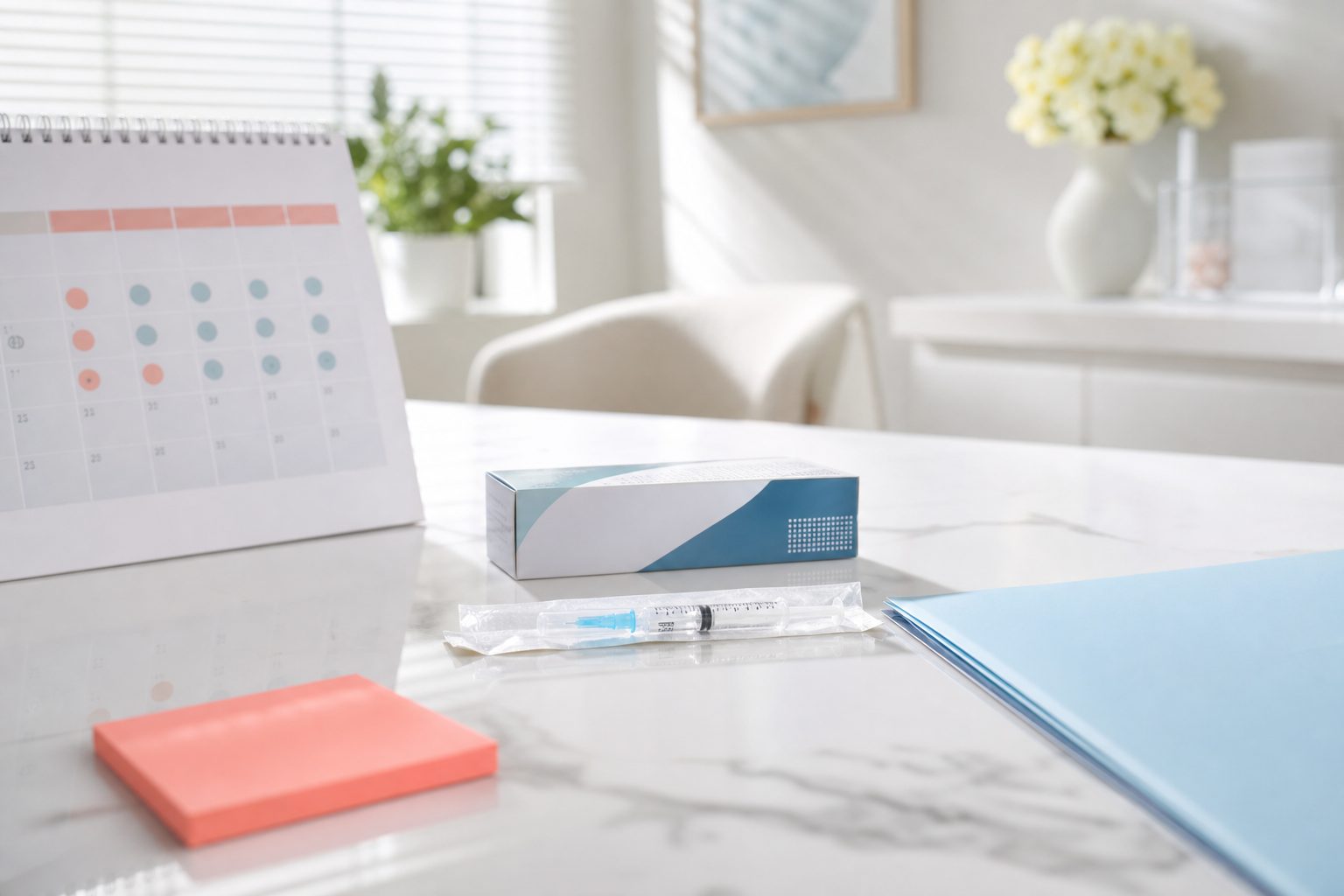
You build a calendar a patient can follow by removing every decision she would otherwise have to make at 9 p.m. in her kitchen. That means one row per calendar date, the exact product name she will read on the box, the dose in the unit printed on the pen or the syringe, the time window, and a plain sentence about what happens if something goes wrong. No abbreviations, no clinic shorthand, no math.
The failure mode is almost never that the patient does not care. She cares more than anyone in the building. The failure mode is that the calendar was written by someone fluent in the protocol for someone who has never held a mixing vial, and the gaps get filled by guessing or by a phone call to the after hours line.
Here is how coordinators structure the document so that the guessing stops, along with the three points in a typical antagonist cycle where calendars reliably break.
What the patient is actually being asked to do each night
Strip the protocol down to the physical tasks. On a standard antagonist stimulation cycle, a patient is doing some combination of: reconstituting a lyophilized powder with a supplied diluent, dialing a pen to a unit mark, drawing a fixed volume from a prefilled vial, swapping a mixing needle for an injection needle, pinching an abdominal site, and disposing of a sharp.
Each of those is a separate skill. A patient on follitropin by pen plus a menotropin by vial is doing two entirely different physical procedures in the same fifteen minutes, with two different needle lengths, and one of them involves not shaking the vial.
Your calendar should name the physical task, not just the drug. "Gonal-f pen, dial to 225" is a different instruction from "Menopur, 2 vials into 1 mL diluent." Writing both as "225 / 150" on a grid assumes she already knows which one is which.
The three questions that generate after hours calls
- Do I take these at the same time or is there a gap?
- I have leftover liquid in the vial, was I supposed to use it all?
- I did the injection an hour late, does that ruin the cycle?
Answer all three in the calendar itself. The third one especially: a stated tolerance window prevents a 2 a.m. call, and it prevents the far worse outcome of a patient skipping a dose because she believes she has already spoiled it.
Keep reading: What does SART and CDC cycle reporting actually require from our clinic each year?
Writing dose lines that survive a 6 a.m. reading
A dose line is read tired, in poor light, sometimes on a phone screen at arm's length. Build it in a fixed order and never vary the order between days.
| Element | Write it like this | Not like this |
|---|---|---|
| Product | Gonal-f (follitropin alfa) pen | FSH |
| Dose | 225 IU | 225 |
| Route | Subcutaneous, abdomen | SQ |
| Time | Evening, between 6 and 9 p.m. | PM |
| Order | Injection 1 of 2 tonight | (omitted) |
Two conventions matter more than they look. First, always print both the brand name and the generic, because the pharmacy may ship a different brand than the one you named at teaching, and a patient holding a box that does not match her paper will stop. Second, number the injections within a night. "1 of 2" tells her at a glance whether she is finished.
Spell out units. IU and mL are the two that get conflated, and the consequence of confusing them is not symmetrical. Write "IU" every time, never leave a bare number.
Where antagonist start and trigger timing break the calendar
Most calendars are printed at cycle start with stimulation days one through five filled in and the rest blank or estimated. That is honest, but it creates two cliffs.
The first cliff is antagonist start. Whether ganirelix or cetrorelix begins on a fixed stimulation day or on a lead follicle criterion, the patient usually does not have it on her printed sheet, because the decision comes out of a monitoring visit. She then receives it verbally over the phone while standing in a parking lot.
The second cliff is trigger. The hour is exact, the drug may be different from anything she has used, and the instruction often arrives late in the day.
Both cliffs are calendar problems, not clinical problems. The fix is to print stand-in rows for them from day one, marked as pending, so that when the call comes she is writing into an existing slot rather than onto a napkin. A row that reads "Antagonist start: date to be confirmed at monitoring, likely stim day 5 or 6, ganirelix 250 mcg, morning" gives her the shape of the thing before the detail arrives.
Keep reading: Should we schedule monitoring in a fixed morning block or open slots across the day?
Handling mid cycle dose changes after a monitoring visit
This is where phone tag is born. Bloodwork resolves late morning, a physician reviews mid afternoon, a coordinator calls, the patient is in a meeting, and the callback lands at 5:40 p.m. for a 7 p.m. injection.
Two rules keep this clean.
- Never issue a change verbally without a written version the patient can look at while injecting. A voicemail saying "we are dropping you to 150" is not a dose line. It has no unit, no product, no confirmation.
- Restate the whole night, not the delta. If she is on two drugs and one changes, say both. "Tonight: Gonal-f 150 IU, and Menopur 75 IU as before. Two injections." The word "as before" is doing real work.
Then close the loop. A dose change is not delivered until the patient has confirmed she read it. This is the single highest value confirmation in the whole cycle, and it is the one most often left as an assumption.
Refrigerated versus room temperature medication notes
Storage errors tend to surface as a wasted vial and a same day pharmacy scramble, which is a cost problem as much as a clinical one.
Put a storage column on the calendar rather than burying it in a teaching packet. The practical distinctions a patient needs:
- Which products live in the refrigerator before first use, and which are fine in a cupboard.
- Which change status after first use, since several pens move to a limited room temperature window once opened.
- How long a product may sit out during transit, and what to do if it exceeded that.
- Whether to let a refrigerated product warm before injecting, which reduces sting and is a comfort issue that affects adherence.
Always follow the manufacturer's package insert for the specific product she was dispensed, and say so on the sheet. Brands differ, and the version she has in hand is the authority.
The travel case
Patients travel during stimulation more often than protocols assume. Give them a written line about carrying medication in hand luggage with a cool pack rather than in checked baggage, and about the fact that syringes and needles are permitted through security when accompanied by the medication and labeling. Being able to point at a clinic document at a checkpoint is worth more than being right.
See how FertilityWindow handles this for fertility clinic patient coordination
Building the trigger night instruction so the hour is unmistakable
Trigger is the one instruction where an hour of drift has a real consequence, because retrieval is scheduled off it. Write it as its own page, not a row.
A trigger instruction should contain, in this order:
- The date, written out: Thursday, October 15.
- The clock time with a.m. or p.m. spelled out, plus the time zone if any part of your patient population crosses one.
- The product and dose, generic and brand.
- An explicit statement of what to stop: "Do not take any other injections after this one unless we call you."
- The retrieval arrival time and the fasting instruction, since the two are always asked together.
- A callback number and a sentence saying to call if the hour is missed by more than a stated amount rather than self correcting.
Have the patient read the hour back. Not "does that make sense," which invites a yes. Ask her to say the day and the time out loud, and write in the chart that she did.
What to hand a patient at consent versus at cycle start
These are two different documents and merging them is why patients arrive at teaching already overwhelmed.
| At consent | At cycle start |
|---|---|
| Protocol shape and expected number of monitoring visits | Dated calendar with actual dates |
| Drug list for the pharmacy and prior authorization | Dose lines per night |
| Cost estimate and what is not included | Storage and mixing notes for the exact products dispensed |
| Risks, including ovarian hyperstimulation warning signs | Who to call, at which hours, and how fast to expect a reply |
| Sharps disposal plan | Stand-in rows for antagonist and trigger |
The consent packet is for deciding. The cycle start calendar is for doing. A patient reading about hyperstimulation risk on the same page as tonight's dose will remember neither well.
Where to go from here
Nothing above requires new clinical practice. It requires that the calendar be a living document rather than a printout, that mid cycle changes reach the patient in writing, and that you can see who has confirmed and who has not without calling to find out.
That is exactly what FertilityWindow is built for: cycle calendars with per night dose lines, monitoring dates that update when the plan changes, and patient confirmations flowing back to the clinic so your coordinators stop chasing. Start by rebuilding one protocol's calendar in the format above, run it on the next three patients, and count the after hours calls you no longer take.